Substructure conditions throughout the lower Mississippi River basin experience extreme sustained ambient humidity, which frequently forces raw moisture upwards into foundational floor joists. Homes in historic…
Substructure conditions throughout the lower Mississippi River basin experience extreme sustained ambient humidity, which frequently forces raw moisture upwards into foundational floor joists. Homes in historic Midtown, Cooper-Young, and Central Gardens often stand on pier-and-beam brick foundations where uncovered soil draws subterranean groundwater, creating relative humidity levels exceeding 75 percent. Under these microclimate conditions, eastern subterranean termites thrive, as detailed in structural protection guidance from the USDA Agricultural Research Service. Unchecked subfloor dampness softens southern yellow pine subflooring, attracting structural wood-destroying organisms and wood-boring beetles described by the University of Kentucky Department of Entomology. ClearHarbor Bug Management stabilizes these structural voids by establishing sealed ground protection that prevents ground moisture from evaporating into livable spaces overhead.
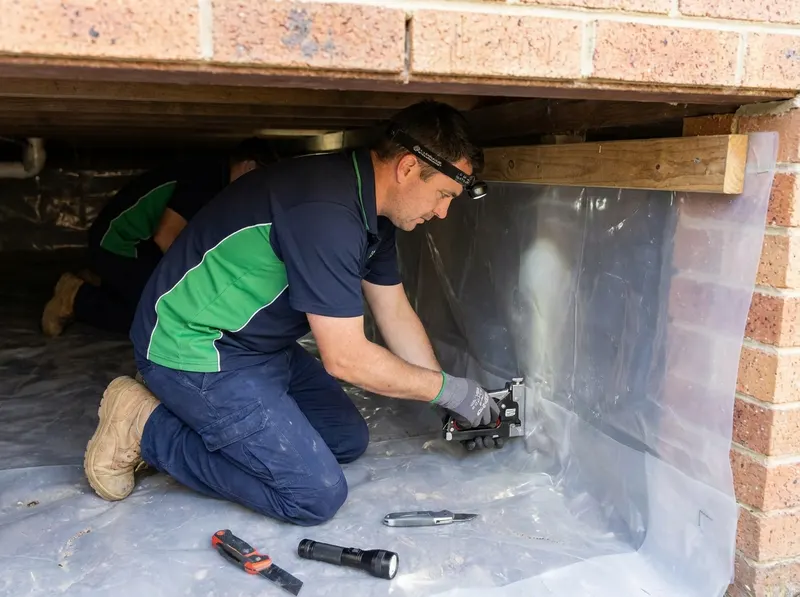
Installing a moisture and pest barrier eliminates the dark, damp subterranean habitats favored by nocturnal pests. Homes situated across East Memphis, Binghampton, and Berclair regularly experience nocturnal perimeter movements from oriental and American cockroaches looking for water sources. Without an adequate physical ground sheet, exposed clay holds seasonal rainfall runoff, creating a steady vapor source that causes subfloor insulation to sag and harbor rodents. Guidelines from the United States Environmental Protection Agency show that lowering structural humidity below 50 percent stops active fungus growth and makes substructures unviable for invasive pests. Soil-gas and moisture mitigation standards published by the U.S. Department of Housing and Urban Development specify covering bare dirt floors completely with continuous sheeting to prevent continuous vapor migration into the building envelope. Technicians mechanically anchor tear-resistant, puncture-proof 12-mil to 20-mil polyethylene sheeting across the entire earth floor, lapping sheets a minimum of 12 inches and sealing seams with waterproof acrylic bonding tape.
The pest exclusion process extends beyond simple ground plastic. Concrete piers, foundation perimeter stems, and utility penetrations receive fitted vertical flashings to eliminate bypass avenues for pests. According to standards established by the Building Science Corporation, crawl space ground covers must remain permanently secured and sealed around structural supports to preserve foundation timber longevity. ClearHarbor Bug Management applies an inorganic borate wood treatment directly to raw sill plates, girders, and subfloor joists to create an insecticidal deterrent barrier against termite galleries, aligned with application recommendations from the USDA Forest Products Laboratory. This inorganic salt application renders structural framing unpalatable to wood-destroying insects without off-gassing volatile compounds into bedroom spaces. Exterior crawl space vents are fitted with corrosion-resistant 1/4-inch steel mesh screens that satisfy exclusion criteria recommended by the Centers for Disease Control and Prevention, stopping roof rats and Norway rats from entering foundation access wells.
Substructure barriers provide a balance between mechanical air sealing and soil moisture isolation. In modern crawl spaces located in Cordova, Raleigh, and Whitehaven, exterior wall foundation vents can pull high outdoor humidity into cool subfloors during summer months, leading to condensation on air ducts. Field standards from the Advanced Energy research institute demonstrate that sealing foundation vents alongside installing continuous ground covers reduces crawl space relative humidity by up to 30 percent compared to open-vent models. The trade-off involves balancing natural vent drying versus closed conditioned air; an unvented crawl space requires dedicated moisture removal to prevent stagnant moisture pockets. In situations where indoor plumbing leaks or standing exterior groundwater accumulate, technicians resolve exterior drainage gradients and clear damp debris before any membrane is permanently fastened, complying with residential energy-efficiency and moisture metrics published by the U.S. Department of Energy and the Natural Resources Conservation Service. ClearHarbor Bug Management operates mobile field units across Memphis without a public walk-in storefront, dispatching directly to residential properties with free on-site inspections.
Every job gets a firm, written price after a free on-site visit.
Tell us about your crawl space moisture and pest barrier job in Memphis and we'll send a clear, written quote, usually the same day.
 ClearHarbor Bug Management